
- Home
- About Us
- Carpet Cleaning
- Upholstery Cleaning
- Other Services
- Blog
- Contact
Need Help? Talk to an experts
- Home
- About Us
- Carpet Cleaning
- Upholstery Cleaning
- Other Services
- Blog
- Contact
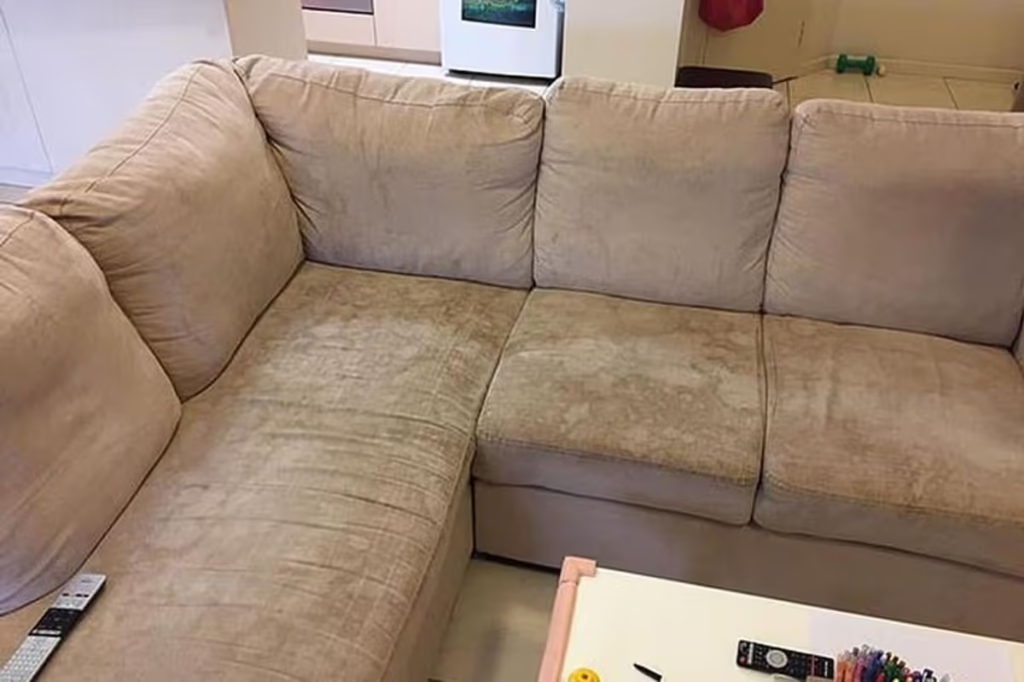
A sofa is one of the most used pieces of furniture in any home. We sit on it daily, relax after work, watch films, drink coffee, snack, and often allow children or pets to treat it as their favourite spot. Despite this constant use, sofas are surprisingly easy to overlook when it comes to proper cleaning.
Over time, dust, crumbs, body oils, allergens and bacteria build up deep inside the upholstery. While a quick vacuum helps on the surface, it does not fully address what is happening with the fabric or leather. Knowing how to clean a sofa properly not only improves appearance but also extends its lifespan and supports a healthier indoor environment.
This guide explains how to clean different types of sofas at home, what to avoid, and when professional sofa cleaning becomes the safer option.
Things to Check Before You Clean Any Sofa
Before you start cleaning your sofa, it’s essential to pause and understand one key thing: not all sofas are the same. Sofas differ not only in construction, but also in the materials used to cover them — and this makes a huge difference when it comes to safe cleaning.
In simple terms, sofas can be divided into three main groups:
Fabric sofas, which include both synthetic fibres and fine or natural fabrics
Leather and leather-look sofas
Specialist or delicate materials, which require professional handling
Before applying any water, detergent or cleaning method, you must first identify what material your sofa is made of. Cleaning the wrong material in the wrong way can permanently damage the upholstery.
Step One: Identify the Upholstery Material
The safest place to start is the manufacturer’s label, usually found:
Under the seat cushions
On the underside of the sofa
On the frame or base
This label may tell you the type of material used or provide cleaning codes such as:
W – water-based cleaning allowed
S – solvent-based cleaning only
WS – both methods may be used
X – vacuum only
If you find these codes, great — they offer useful guidance.
However, don’t panic if you can’t find them. Many sofas, especially older ones, don’t include clear cleaning symbols. In that case, identifying the upholstery material itself is more important than the code.
Once you know what your sofa is covered with, it becomes much easier to decide whether home cleaning is safe or whether it should be left to a professional.
Fabric Sofas: Synthetic vs Natural Fibres
Fabric sofas can be broadly divided into synthetic fibres and natural or fine fabrics — and this distinction is crucial.
Synthetic fibres – green light for careful home cleaning
If your sofa is covered in synthetic fibres, home cleaning is generally safe when done correctly. Common synthetic upholstery materials include: Polypropylene, Polyester, Nylon, Acrylic, Microfibre, Blends of the above fibres
These materials are designed to be more durable, colour-stable and moisture-resistant. If your sofa is made from synthetic fibres or their blends, your attempt at cleaning it at home has a green light, provided you use mild products and avoid over-wetting.
Natural and fine fabrics – do not clean!
If your sofa is covered with natural fibres or delicate blends, home cleaning is strongly discouraged.
This includes: Wool, Cotton, Linen, Viscose, Silk any blends containing these fibres
This is my honest advice:
Do not attempt to clean these fabrics yourself. Use professional service provider.
Natural and fine fabrics react very differently to moisture and standard household products. They are highly absorbent, prone to colour movement, watermarking and texture damage. Cleaning them safely requires: Low-pH specialist solutions, Controlled moisture levels, Powerful extraction equipment.
These products and machines are not available in supermarkets and cannot be replaced with DIY mixtures. Attempting to clean natural fabrics at home often ends with irreversible damage — patchy colour, stiff texture or permanent water marks.
In short:
Synthetic fibres – yes, with care
Natural or fine fabrics – no, leave them to a professional
Leather Sofas: Mostly Easy, One Important Exception
Most leather sofas are surprisingly easy to clean and maintain — as long as the leather is finished and pigmented.
Leather sofas in colours such as cream, beige, brown or black are typically coated with a protective finish. This makes them suitable for: gentle cleaning with dedicated leather products and routine maintenance to keep the surface ind good condition.
When cared for properly, these leathers respond very well to regular cleaning and conditioning.
Leather is a specific material that requires regular care. It should be wiped frequently with a slightly damp cloth to remove surface dirt, but it also needs more involved maintenance, such as applying a leather conditioner or protecting the surface with a layer of specialised polymers.
All of this can be done at home — and later in this article, I’ll show you exactly how to do it safely and effectively.
How to Clean a Fabric Sofa at Home
Cleaning a fabric sofa at home can be effective only if it’s done correctly and with realistic expectations. The goal of DIY cleaning is to refresh the surface, remove light soiling and deal with small stains — not to replicate a professional deep clean.
Before you begin, make sure your sofa is covered in synthetic fibres such as polyester or polypropylene. Natural and fine fabrics should always be left to a professional, as explained earlier.
If You Have an Extractor with Upholstery Tool
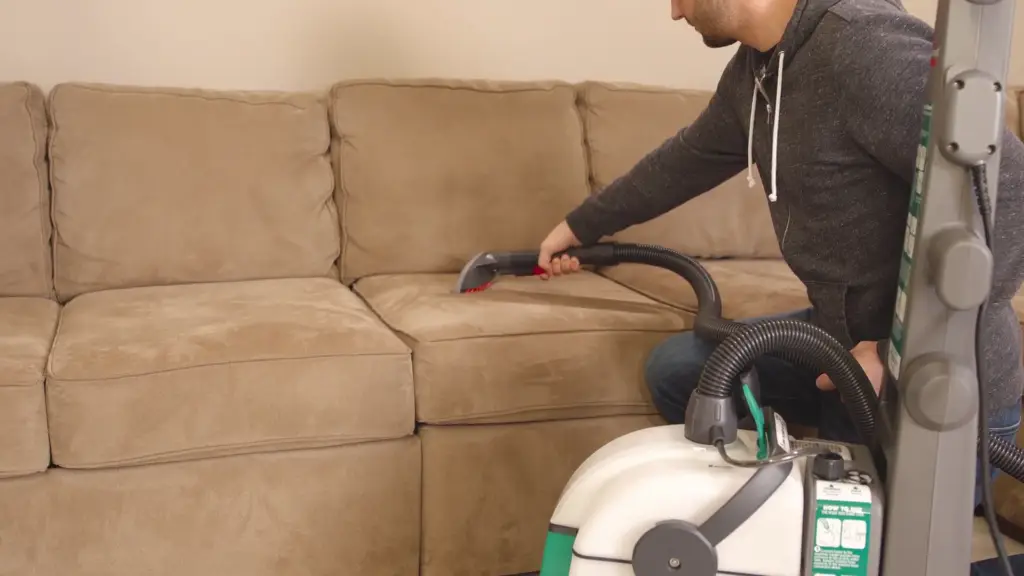
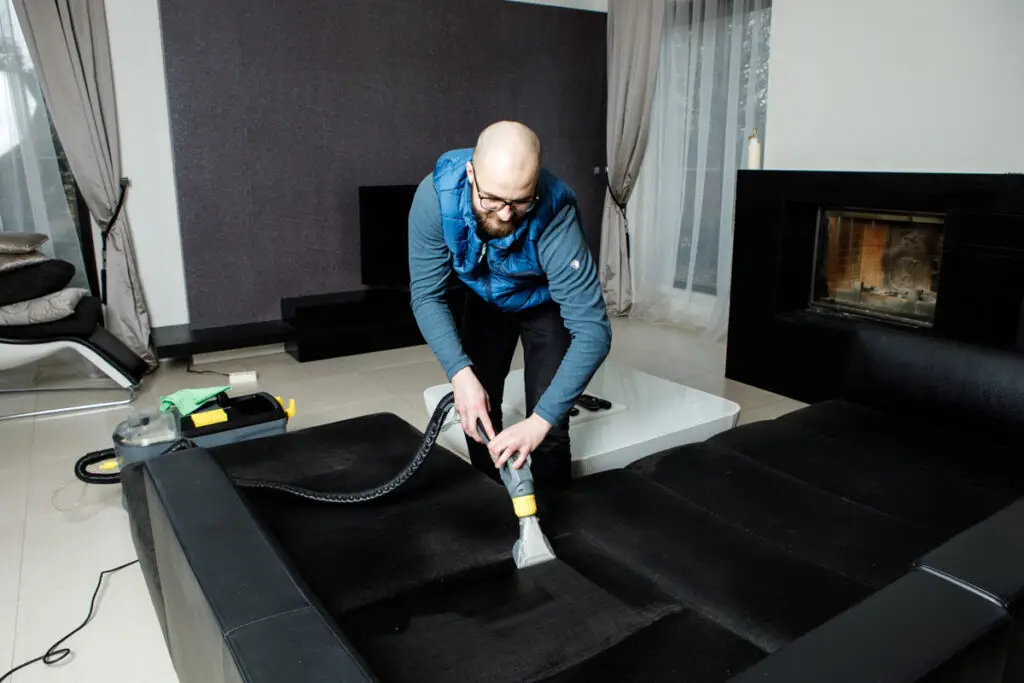
If you own or can access an upholstery extraction machine, you’re already in a much better position to clean your fabric sofa safely.
The process you will be carrying out is called hot water extraction.
In addition to the extraction machine itself, you will need a few basic tools: a small pump sprayer or a spray bottle (for example, an empty window-cleaning bottle), a soft brush — a hairbrush or a nail brush works very well — and a dedicated upholstery cleaning solution.
Choose a detergent designed for fabric upholstery, ideally with a pH level not exceeding 9–10, to ensure effective cleaning without damaging the fibres.
Step 1: Vacuum First — Always
Even when using an extractor, vacuuming is non-negotiable. Dry soil makes up the majority of dirt in upholstery, and skipping this step turns it into nightmare during extractiuon process.
Step 2: Applying Detergent and Agitation
Once the sofa has been thoroughly vacuumed, the next stage is applying the cleaning detergent and gently agitating the fibres.
Apply a fabric-safe upholstery detergent using a small pump sprayer or spray bottle. Lightly mist the surface — the fabric should be damp, not wet. The purpose at this stage is to allow the detergent to break down oils and dirt bonded to the fibres, not to soak the upholstery.
Next, gently agitate the fabric using a soft brush.
Brush lightly and evenly, working the solution into the fibres without applying excessive pressure. This helps loosen embedded dirt and improves overall cleaning results.
Avoid aggressive scrubbing, which can damage the fabric texture, cause fuzzing or distort the weave. Work in small sections and allow the detergent a short dwell time (5-10min) before moving on to extraction.
Step 3: Extraction
Once the area has been treated with detergent and properly agitated, it’s time for extraction.
Fill the machine with warm water at around 60–70°C. Do not use boiling water — most domestic extraction machines are not designed to handle extreme temperatures. The clean water tank should be filled with water only.
If you’re willing to take a small risk and your machine’s pump can handle it, you may add a small splash of fabric rinse or conditioner with a pleasant scent. This is optional and should be done cautiously.
Begin by extracting the treated area using dry passes only. Work from top to bottom, without rinsing. The purpose of this stage is to remove as much detergent residue and loosened dirt as possible. Rinsing too early can push contamination deeper into the upholstery.
Remember — this machine is still a domestic tool, not professional equipment.
Continue making dry passes until you can no longer see anything being removed — foam, dirty water or residue of any kind.
Once this stage is complete, perform one controlled wet pass, again from top to bottom. Never rinse from bottom to top. The logic is simple: the area hit by the water jet should be immediately extracted.
After a single wet pass, finish with as many dry passes as possible to pull out maximum moisture and reduce drying time.
Congratulations — you have just completed the hot water extraction process.
Step 4: Drying
Leave the sofa to dry completely before using it again.
In summer, open the windows and create a cross-draft to allow fresh air to circulate through the room. Good airflow significantly shortens drying time and helps prevent lingering odours.
In winter, increase the indoor temperature to around 20°C and place a fan in the room to keep the air moving. Sofa cushions can be placed near a radiator, but never directly against it, as excessive heat can damage the fabric.
During colder months, it’s also helpful to ventilate the room periodically and keep internal doors open. This allows moisture to disperse throughout the house rather than remaining trapped in a single space, reducing the risk of damp smells or slow drying.
Cleaning a Fabric Sofa Without an Extractor
If you don’t have access to an upholstery extractor, sofa cleaning is still possible — but it follows a different principle and comes with clear limitations.
This method closely resembles a process known as encapsulation cleaning. In simple terms, there is no extraction stage, which means the cleaning solution remains in the fabric because it cannot be rinsed out.
In professional encapsulation systems, the chemical agent crystallises as it dries and is later removed through vacuuming. Unfortunately, products that truly work this way are rarely available to individual consumers. Personally, I don’t know of any genuine encapsulation products sold for home use.
For this reason, a practical alternative is to mix a small amount of water with Vanish in a bowl and whip it into a very thick foam. This foam becomes your cleaning agent.
Apply the foam using a sponge or a soft brush. As with the previous method, the process starts with thorough vacuuming. Then, instead of spraying liquid, apply small amounts of foam and gently clean the sofa section by section.
This approach works well for light to medium soiling and general surface refreshment.
It’s important to note that Vanish is a strong cleaning product, and because the detergent remains in the fabric, professional sofa cleaning is recommended every 12–18 months. A specialist deep clean will not only remove accumulated dirt but also flush out the chemical residue left behind by DIY cleaning. Do not mention that Vanish was in use – he will charge more 🙂
How to Clean a Leather Sofa – Step by Step
Cleaning a leather sofa is a multi-stage process, but when done correctly, it delivers excellent results and significantly extends the life of the leather.
The most important thing to understand is this: leather responds best to regular, gentle care, combined with periodic, more advanced maintenance. Both can be done at home — as long as the leather is not aniline (more on that at the end).
Everyday Leather Sofa Maintenance
A leather sofa can always be safely wiped as part of regular maintenance.
Use a clean cloth dampened with hot water, then wring it out thoroughly so it is almost dry. The cloth should feel warm, not wet. Rinse the cloth frequently during this process to avoid spreading dirt back onto the surface.
Wipe the sofa section by section. Once a section is cleaned, immediately dry it using a separate dry towel until the surface is completely dry.
This is the simplest and safest form of leather maintenance, and it can be done very often — even every few days. Sofas that are wiped regularly stay cleaner, age better and are far easier to maintain over time.
Periodic Deep Maintenance: Cleaning, Conditioning and Finishing
Leather sofas that are used intensively — especially in busy households — also require periodic deep maintenance. This goes beyond basic wiping and consists of three additional stages:
Cleaning
Conditioning
Finishing (protection)
For this type of maintenance, it’s strongly recommended to use professional leather-care products: a dedicated leather cleaner, conditioner and finish (available in matte or gloss).
Step 1: Deep Cleaning
Apply the leather cleaner using a spray bottle. Lightly spray the product onto the surface and clean using a soft cloth or sponge.
Allow the cleaner a short dwell time, then wipe the area thoroughly. The amount of dirt removed at this stage often surprises people — even sofas that appear clean hold a significant amount of hidden contamination.
Keep a bowl of warm water nearby, along with:
One cloth dampened with clean water
One dry towel
After cleaning with the leather cleaner, wipe the surface with the damp cloth to remove any remaining chemical residue. Then dry the leather completely using the dry towel.
At this point, your sofa is perfectly clean — but unprotected. The cleaning process removes not only dirt, but also the existing protective layer.
Step 2: Conditioning the Leather
Conditioning is a critical step that should never be skipped.
Apply the leather conditioner onto a cloth, not directly onto the leather, and work it evenly across the entire surface. This ensures controlled application and prevents over-saturation.
Once applied, allow the conditioner to dry fully. Its role is to hydrate and soften the leather, keeping it flexible and preventing cracking over time. Thanks to this step, leather remains comfortable, resilient and visually appealing.
Step 3: Applying the Finish (Protection)
Once the conditioner has dried, move on to the final stage: finishing.
The finish is a protective layer made of specialised polymers. It shields the leather from:
Environmental influences
Drying and moisture loss
Minor scratches and everyday wear
Apply the finish using a clean cloth, working evenly across the surface. Typically, one to two thin layers are sufficient. Allow each layer to dry before applying the next.
Once fully dry, gently polish the leather with a dry cloth to achieve the desired appearance — matte or gloss, depending on the product used.
FAQ
How do you clean a sofa at home?
You can clean a sofa at home only if it’s covered in synthetic fabric or finished leather. Start with thorough vacuuming, use mild upholstery-safe products, control moisture carefully and allow proper drying. Home cleaning is best for light to medium soiling, not deep restoration.
What is the best way to clean a fabric sofa?
The best way to clean a fabric sofa is controlled hot water extraction, provided the sofa is made from synthetic fibres. This method uses detergent, gentle agitation and extraction to remove dirt without over-wetting. Natural fabrics should always be cleaned professionally.
Can you clean a fabric sofa with water?
Yes, but only synthetic fabric sofas can be cleaned with water — and only in controlled amounts. Over-wetting can cause odours, water marks and damage to padding. Natural fabrics like wool, cotton or viscose should never be cleaned with water at home.
How do you clean a fabric sofa without an extractor?
Without an extractor, fabric sofa cleaning relies on surface methods similar to encapsulation. Use thick foam rather than liquid, apply it gently with a sponge or soft brush, and vacuum thoroughly. This method is suitable only for light to medium soiling.
Is steam cleaning safe for fabric sofas?
Steam cleaning is not always safe for fabric sofas. High heat and moisture can damage fibres, loosen adhesives and cause over-wetting. Unless carried out with professional equipment and proper extraction, steam cleaning often creates more problems than it solves.
What is hot water extraction for sofa cleaning?
Hot water extraction is a process where detergent is applied to upholstery, agitated to loosen dirt, and then rinsed and removed using an extraction machine. It’s the most effective method for cleaning synthetic fabric sofas when moisture is properly controlled.
Can hot water extraction damage a sofa?
Yes, if done incorrectly. Using boiling water, excessive detergent, poor extraction or repeated rinsing can damage upholstery and internal padding. When done carefully, with warm water and proper drying, hot water extraction is safe for synthetic fabrics.
How long does a sofa take to dry after cleaning?
Drying time typically ranges from 4 to 12 hours, depending on airflow, temperature and moisture levels. Good ventilation, fans and warm indoor temperatures significantly reduce drying time and help prevent damp smells.
Why does my sofa smell after cleaning?
Sofa odours after cleaning are usually caused by trapped moisture. Over-wetting and poor drying allow bacteria to develop inside the upholstery. Proper extraction, airflow and complete drying are essential to prevent unpleasant smells. If bad smell occured, call professional – don’t re-clean your sofa!
Can over-wetting damage a fabric sofa?
Yes. Over-wetting can lead to water marks, odours, shrinkage and damage to internal foam and adhesives. Fabric sofas should always be cleaned with minimal moisture and thoroughly dried to avoid long-term problems. This is why professional cleaning is safer!
How do you clean a leather sofa properly?
Leather sofas should be cleaned in stages: regular wiping with a nearly dry cloth, periodic deep cleaning with a leather cleaner, followed by conditioning and protective finishing. This keeps leather clean, soft and protected from cracking and wear.
Can you wipe a leather sofa with water?
Yes, finished leather sofas can be wiped with a cloth dampened in hot water and wrung almost dry. This is safe for regular maintenance. Water should never be used on aniline leather, which stains easily and requires specialist cleaning.
How often should you clean and condition a leather sofa?
Light wiping can be done every few days. Deep cleaning, conditioning and finishing are usually recommended every 6–12 months, depending on usage. Regular maintenance prevents drying, cracking and premature ageing of leather.
What is aniline leather and why is it difficult to clean?
Aniline leather is a premium leather dyed without a protective coating, leaving the natural grain visible. It absorbs liquids easily and stains permanently. Water-based cleaning methods should never be used — professional solvent-based cleaning is required.
When should you use a professional sofa cleaning service?
Professional cleaning is recommended for natural fabrics, heavy soiling, persistent odours, delicate materials and regular maintenance every 12–18 months. Professionals use specialist products and equipment to clean deeply without damaging the sofa.
Facebook
Twitter
LinkedIn
